Хто зустрічався з Shuja al-Khwarazmi?
Al-Mu'tasim від Shuja al-Khwarazmi від ? до ?.
Shuja al-Khwarazmi
Shuja al-Khwarazmi also known as Umm Jaʽfar (Arabic: أم جعفر) or Umm al-Mutawakkil (Arabic: أم المتوكل) was one of the Umm walads of eighth Abbasid caliph al-Mu'tasim and mother of al-Mutawakkil.
Shuja was the concubine of Abbasid prince Muhammad. She entered the abbasid harem probably in 819/820. She was raised in the Abbasid household before Abbasid prince Abu Ishaq Muhammad ibn Harun kept her as a concubine. She was related to Musa ibn Bugha the Elder. The meaning of her name was Brave and Courageous. She gave birth to Muhammad's son Jafar (future Al-Mutawakkil).
Al-Mutawakkil was born on February/March 822 to the Abbasid prince Abu Ishaq Muhammad (the future al-Mu'tasim) his concubine from Khwarazm called Shuja. She was of Turkic origin
The Early life of Shuja is unclear because the Early life of Al-Mutawakkil is obscure, as he played no role in political affairs until the death of his older half-brother, al-Wathiq, in August 847. When her son became Caliph, he gave his mother Shuja, a degree of financial power to the extent that she had about 500,000 dinar and several pieces of land; however, there is no mention in sources that she had any political power. Shortly after her son became Caliph, Shuja decided to perform hajj.
Shuja was generous, when she went on the pilgrimage, Al-Mutawakkil accompanied her to bid her goodbye. When she reached Kufa she ordered that each of the Abbasid (descendants of Abbas) and the Talibid men (descendants of Abu Talib) were to receive one thousand dinars while every women was to receive five hundred dinars, while every men from Al-Muhajirin was to receive a hundred dinars, while every women was to receive ten dinars. She left behind fifty thousand dinars and more than a million dinar worth jewelry.
Shuja died in June–July 861. Her wealth was inherited by her grandchildren.
Детальніше...Al-Mu'tasim
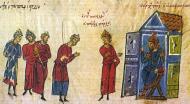
Abū Isḥāq Muḥammad ibn Hārūn al-Rashīd (Arabic: أبو إسحاق محمد بن هارون الرشيد; October 796 – 5 January 842), better known by his regnal name al-Muʿtaṣim biʾllāh (المعتصم بالله, lit. 'He who seeks refuge in God'), was the eighth Abbasid caliph, ruling from 833 until his death in 842. When al-Ma'mun died unexpectedly on campaign in August 833, al-Mu'tasim was thus well placed to succeed him, with the support of the powerful chief qādī, Ahmad ibn Abi Duwad, he continued to implement the rationalist Islamic doctrine of Mu'tazilism and implementing miḥna policy.
A younger son of Caliph Harun al-Rashid (r. 786–809), he rose to prominence through his formation of a private army composed predominantly of Turkic slave-soldiers (ghilmān, sing. ghulām). This proved useful to his half-brother, Caliph al-Ma'mun, who employed al-Mu'tasim and his Turkish guard to counterbalance other powerful interest groups in the state, as well as employing them in campaigns against rebels and the Byzantine Empire.
Although not personally interested in literary pursuits, al-Mu'tasim also nurtured the scientific renaissance begun under al-Ma'mun. In other ways, his reign marks a departure and a watershed moment in Islamic history, with the creation of a new regime centred on the military, and particularly his Turkish guard. In 836, a new capital was established at Samarra to symbolize this new regime and remove it from the restive populace of Baghdad.
The power of the caliphal government was increased by centralizing measures that reduced the power of provincial governors in favour of a small group of senior civil and military officials in Samarra, and the fiscal apparatus of the state was more and more dedicated to the maintenance of the professional army, which was dominated by Turks. The Arab and Iranian elites that had played a major role in the early period of the Abbasid state were increasingly marginalized.
This strengthened the position of the Turks and their principal leaders, Ashinas, Wasif, Itakh, and Bugha. Another prominent member of al-Mu'tasim's inner circle, the prince of Ushrusana, al-Afshin, fell afoul of his enemies at court and was overthrown and killed in 840/1. The rise of the Turks would eventually result in the troubles of the 'Anarchy at Samarra' and led to the collapse of Abbasid power in the mid-10th century, but the ghulām-based system inaugurated by al-Mu'tasim would be widely adopted throughout the Muslim world.
Al-Mu'tasim's reign was marked by continuous warfare. The two major internal campaigns of the reign were against the long-running Khurramite uprising of Babak Khorramdin in Adharbayjan, which was suppressed by al-Afshin in 835–837, and against Mazyar, the autonomous ruler of Tabaristan, who had clashed with the Tahirid governor of Khorasan and risen up in revolt. While his generals led the fight against internal rebellions, al-Mu'tasim himself led the sole major external campaign of the period, in 838 against the Byzantine Empire. His armies defeated Emperor Theophilos and sacked the city of Amorium. The Amorium campaign was widely celebrated, and became a cornerstone of caliphal propaganda, cementing al-Mu'tasim's reputation as a warrior-caliph.
Детальніше...